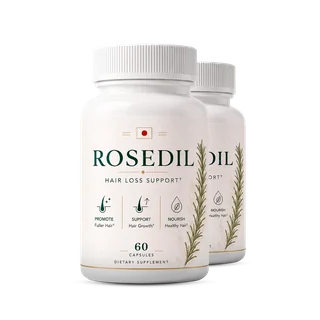
Rosedil Capsules list zinc, as zinc oxide, at 12 mg per serving of two capsules, which the label prints as 109% of the Daily Value. The number to keep beside it is NIH's upper limit for adults, 40 mg a day from all sources. This page shows how the 109% is worked out, where 12 mg sits against that limit, and how to add up zinc if you also use a multivitamin.
How much zinc is in Rosedil Capsules?
One serving of Rosedil Capsules, which is two capsules, lists 12 mg of zinc, supplied as zinc oxide, according to the Supplement Facts panel on the label image the owner supplied. That is about 6 mg in each capsule and about 360 mg of zinc in a full 30-serving bottle (our arithmetic).
The panel prints the amount with a Daily Value of 109%. The panel does not print the zinc oxide weight, only the zinc itself, which matches how NIH says Supplement Facts panels work: they list the amount of elemental zinc, not the weight of the compound.1 You can see the panel line next to the other seven in supplement facts.
What is the Daily Value for zinc, and where does 109% come from?
The adult Daily Value for zinc is 11 mg, according to the NIH Office of Dietary Supplements.1 Divide 12 mg by 11 mg and you get 1.09, which is the 109% on the panel.
A Daily Value is a reference number printed on labels so products can be compared. It is not a prescription and not a limit. The line to watch for safety is a different one, the upper level, which comes next. Put in plain numbers, 12 mg is only 1 mg more than the reference number, so this is not a line where the percentage looks dramatic. It is the total from every product you use that deserves a look.
050100 % of upper level
Our arithmetic from the label panel and NIH upper levels for adults. Biotin, B5 and horsetail have no upper level to compare with. An upper level is a ceiling for total intake from supplements, not a target; your other products count too.
Show the numbers
| Item | Value |
|---|---|
| Niacin, 30 mg of 35 mg | 86% |
| Zinc, 12 mg of 40 mg | 30% |
| Vitamin C, 157 mg of 2,000 mg | 8% |
| Vitamin B6, 1.6 mg of 100 mg | 2% |
Source: Label panel image; NIH Office of Dietary Supplements fact sheets; our arithmetic.
What is the upper limit for zinc?
NIH sets the tolerable upper intake level for zinc at 40 mg a day for adults, counting zinc from food, fortified foods and supplements together.1 One serving of Rosedil Capsules is 12 mg, which is 30% of that limit, so 28 mg remains under it before any other product is counted (our arithmetic).
NIH also notes that sustained intakes of 50 mg or more a day for weeks can interfere with copper absorption, and that large amounts can affect immune function and HDL cholesterol.1 Those effects are tied to amounts above the upper level, not to 12 mg. The point of knowing them is to see why a second or third zinc-containing product matters, as the next sections show.
| Zinc amount | Source | Share of 40 mg limit |
|---|---|---|
| 11 mg | Adult Daily Value | 28% |
| 12 mg | One Rosedil Capsules serving | 30% |
| 40 mg | Adult upper level, all sources | 100% |
| 50 mg or more | Sustained amounts NIH links to copper interference | above the limit |
How do you add up zinc from several products?
Add the zinc amount from each supplement label to the 12 mg in a serving of Rosedil Capsules, and compare the total with 40 mg. Count only the milligrams of zinc, and count each product once for each serving you take.
A simple way to do it by hand:
- Write down each product with a zinc line: multivitamins, mineral formulas, immune formulas, lozenges.
- Note the milligrams of zinc per serving and how many servings you take in a day.
- Multiply, add the products together, then add 12 mg for one serving of Rosedil Capsules.
- Compare with 40 mg. If you are close or over, ask a pharmacist before adding anything.
Food adds some zinc as well, and NIH counts it toward the same 40 mg. If your multivitamin lists zinc as, say, 11 mg, the running total with Rosedil Capsules would be 23 mg, still under 40 mg; the arithmetic is the same for any figure. Our niacin page has a tally tool that adds zinc, niacin, B6, vitamin C and biotin from your other products to one Rosedil serving, and it compares each with the NIH upper level where one exists.
What does zinc oxide mean on the label?
Zinc oxide is the form of zinc used in Rosedil Capsules, as printed in the parentheses on the panel: "Zinc (as zinc oxide)". The form matters for absorption: NIH reports that absorption from zinc oxide is about 50% in young adults, against about 61% for zinc citrate or gluconate.1
That is a comparison between forms in one group of adults, not a verdict on the product, and the label does not say how much is absorbed from the capsules. It also means the 12 mg is the amount of zinc in the capsule, and some portion is taken up by the body. The panel lists the elemental amount whichever form is used, so you can compare 12 mg directly with the zinc line on another product's panel, even if the other product uses zinc citrate.
What does NIH say about zinc and hair loss?
NIH lists hair loss among the signs of zinc deficiency, mainly in older children, but the fact sheet does not say that zinc intake causes or treats hair loss.1 That sentence is as far as the source goes, and we stop there as well.
Hair loss has many causes, including heredity, illness, medicines, stress, childbirth and poor nutrition, and a clinician can help find which applies to you.2 The Rosedil label front prints hair words of its own, such as “HAIR LOSS SUPPORT†”; those are the owner's label words, FDA has not evaluated them, and they are not a measured result. For the full set of official statements see our hair loss page.
Who should ask a clinician about zinc first?
Ask a clinician or pharmacist first if you take other zinc products, use medicines, are pregnant or nursing, have a known medical condition, or are under 18. These are the same groups the label's own caution lists.
NIH's copper point is the one most people have not heard of. Long use of 50 mg or more can interfere with copper, so if you are already taking a zinc-heavy product, a second source matters. NCCIH also reminds readers to tell every provider about every supplement they use, and that some medicine and supplement pairings can be serious.3 Never change or stop a prescribed medicine on your own. The medications page lists questions to take to a pharmacist.
What can we not confirm about zinc in Rosedil Capsules?
We cannot confirm anything beyond the printed panel. The owner's pack and label image give the amount, the form and the Daily Value, and nothing else about the zinc: no source of the ingredient, no test of the finished capsules and no figure for how much a person absorbs.
The label also does not say which maker filled the capsules; it names a distributor and says the product was manufactured in a facility the label calls “FDA registered.” Under federal rules, a registration number means only that the facility is registered, not that FDA approves or endorses it or its products.4 If the zinc source or the maker matters to you, ask the order desk in writing before you buy; the order desk questions page has a list you can copy from.
What about the other ingredients on the panel?
Zinc is one of eight panel lines, and not the one with the largest percentage. Biotin carries the largest figure, with its own lab test caution, while niacin comes closest to a published upper level.
For the whole panel, the ingredients page lists all eight lines with their amounts, and safety pulls the cautions together. Zinc's own page ends here for a reason: the number is modest next to its limit, and the useful work is the arithmetic across your other products.
What should you do next?
Add up your zinc using the steps above, read the niacin page for the line closest to its limit, and talk to a pharmacist if your total is close to 40 mg. The label directs two capsules daily with an 8 oz. glass of water; do not exceed it. A bottle holds 60 capsules, so at two capsules a day it covers 30 days, and the zinc total for that period is 12 mg a day from Rosedil Capsules before anything else is counted. Keep your tally written down, with dates, so you can show it to a clinician if you are ever asked what you take.
When you are ready, the owner's pack lists prices that you can compare on the pricing page, to confirm at the live checkout, and you can see the packs at the seller's checkout.
Questions people ask
What amount of zinc do Rosedil Capsules list per serving?
One serving of two capsules lists 12 mg of zinc, as zinc oxide. That is 109% of the 11 mg Daily Value, according to the label image.
Is the zinc in Rosedil Capsules over the upper limit?
No. NIH's upper limit for adults is 40 mg a day from all sources, and one serving of Rosedil Capsules is 12 mg. Other zinc products you take add to that total.
Can I take Rosedil Capsules zinc with a multivitamin?
Add the zinc on the multivitamin's panel to the 12 mg in Rosedil Capsules and compare the total with 40 mg. Ask a pharmacist if the total comes close.
Does Rosedil Capsules zinc come as zinc oxide or citrate?
The panel says zinc oxide. NIH reports that absorption from zinc oxide is about 50% in young adults, compared with about 61% for citrate or gluconate.
Does NIH say Rosedil Capsules zinc affects hair loss?
No. NIH lists hair loss as a sign of zinc deficiency mainly in older children, but does not say that zinc intake causes or treats it. See a clinician for the cause.
Sources for this page
- NIH Office of Dietary Supplements: Zinc, Fact Sheet for Health Professionals. ods.od.nih.gov
- MedlinePlus: Hair loss. medlineplus.gov
- NCCIH: Using Dietary Supplements Wisely. www.nccih.nih.gov
- Electronic Code of Federal Regulations, 21 CFR 1.242: What does assignment of a registration number mean?. www.law.cornell.edu
These statements have not been evaluated by the Food and Drug Administration. This product is not intended to diagnose, treat, cure, or prevent any disease. Safety: Rosedil Capsules are a dietary supplement, not a medicine. One serving (two capsules) lists 4,620 mcg of biotin, which can distort some lab tests (FDA), and 30 mg of niacin, close to NIH's 35 mg upper level for supplements. Ask your doctor or pharmacist before using them, especially if you are pregnant or nursing, under 18, have a medical condition or take medicine, and tell any lab you take biotin. Take no more than the label says, keep the bottle away from children, and report problems to FDA MedWatch. Rosedil is an independently run information site about Rosedil Capsules; the owner states it is the Official U.S. Rosedil shop, and we have not verified that. It is not the maker. We may earn money when you order through links marked as sponsored. The seller sets prices, shipping and refund terms; the prices here are the owner's list, so confirm at the live checkout.