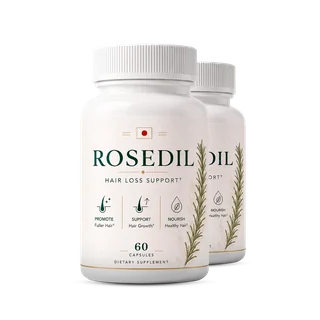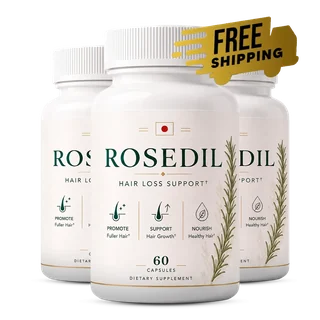
The Rosedil Capsules label claims are four phrases printed on the front of the bottle, each marked with a dagger: “HAIR LOSS SUPPORT†”, “PROMOTE Fuller Hair†”, “SUPPORT Hair Growth†” and “NOURISH Healthy Hair†”. We quote them only as the label's words. This page explains what kind of statement they are, what FDA does and does not evaluate, and why a word on a bottle is not a measured result.
What are the label claims on Rosedil Capsules?
They are four front-of-pack phrases, each ending in a dagger. The first sits under the product name, and the other three sit beside small icons. Quoted exactly as printed, they are “HAIR LOSS SUPPORT†”, “PROMOTE Fuller Hair†”, “SUPPORT Hair Growth†” and “NOURISH Healthy Hair†”.
We do not repeat them as claims of our own, and nothing in the owner's materials shows that the finished capsules do anything to hair. They are the maker's or distributor's wording. On this site, whenever one of these phrases appears, it is inside curly quotes with the dagger, so you can see at a glance whose words they are.
The label itself says what the dagger means: it points to the FDA statement, discussed below. The label page shows the whole wrap.
What is a structure/function statement?
A structure/function statement is a kind of label wording that describes a role a nutrient or ingredient has in the body, rather than naming a disease. FDA does not pre-approve these statements, and a label that carries one must also carry two things: a notice that FDA has not evaluated the statement, and a notice that the product is not intended to diagnose, treat, cure or prevent any disease.1
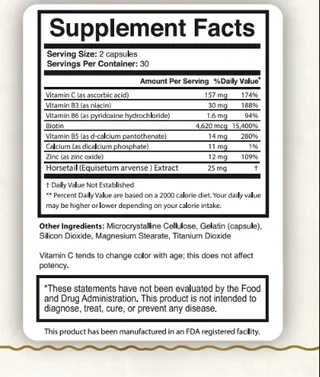
That is why the Rosedil Capsules panel carries this sentence: "These statements have not been evaluated by the Food and Drug Administration. This product is not intended to diagnose, treat, cure, or prevent any disease." The dagger on each front phrase ties it to that sentence.
The practical meaning is simple. The words on the front were not reviewed by FDA before the bottle was sold, and the second sentence says the product is not meant for any disease. Whether a phrase is a claim about the body or about a disease is a legal line that the maker draws, not a result you can see on a shelf.
What does FDA evaluate, and what does it leave alone?
FDA does not approve dietary supplements for safety or effectiveness before they are sold. Makers are responsible for their own products and labels, and FDA can act on problems after a product is on the market.2
| Question | What FDA does | What FDA does not do |
|---|---|---|
| Is the product approved before sale? | No pre-sale approval for safety or effectiveness | Review each bottle before it is sold |
| Are front claims reviewed? | Requires the disclaimer sentence | Pre-approve a structure/function statement |
| Who is responsible for the label? | The maker | Take the maker's place |
| Can you report a problem? | Takes reports | Not applicable |
Seeing a phrase such as “FDA approved” on a supplement should therefore raise a question, because the law does not provide that approval. Our approval page applies this to Rosedil Capsules and to the label's line about a "registered" facility.
Why is a label word not a result?
A label word is a statement of intent, and a result is something measured in people. The two are different kinds of thing, and a bottle can carry the first without any of the second.
For a claim to rest on evidence, the FTC expects the evidence to be competent and reliable science, and expects endorsements and testimonials to be honest and to reflect typical experience.3 Nothing in the owner's pack cites a study of the finished capsules, so we have no measured result to put beside the words.
Three questions turn any front-of-pack phrase into something you can check:
- Is there a study named, and was it done on this product or on a single ingredient?
- Does the study describe people like the reader, at the amount in the bottle?
- Does the wording say "may" or "can", or does it describe an outcome as certain?
On this label, no study is named. The panel lists the ingredients and amounts, which you can read, but the front words are not tied to a test you can look up.
What does NIH say about the biotin on the label?
NIH says the evidence linking biotin to hair is weak: a few case reports and small studies, with more studies needed, especially in healthy people.4 That is about biotin in general. It is not a finding about Rosedil Capsules, which list 4,620 mcg of biotin per two capsules, and it is not a finding about any other nutrient on the panel.
For zinc, NIH lists hair loss as a sign of deficiency, mainly in older children, but its page does not say that zinc intake causes or treats hair loss.5 We read these as limits on what the panel can be taken to mean. If you are curious about the evidence, the biotin and zinc pages set out what each source says and no more.
Why does hair loss itself need a different kind of answer?
Hair loss has many causes, and finding the cause comes before choosing anything. MedlinePlus lists heredity, illness, medicines, radiation, stress, childbirth, menopause and poor nutrition among them, and says that some hair loss needs no treatment at all.6
A front-of-pack phrase cannot tell you which cause applies to you. A clinician can, and that is the person to ask if your hair loss is sudden, patchy, or comes with other symptoms. Our hair loss page explains what the sources say and when to see someone. Reading a bottle's claims is not a substitute for that visit.
How can you sort the claims you meet?
You can sort any phrase from the label, the owner's materials or the market with the tool below. Tap a phrase, and it shows where the phrase comes from and what it does and does not show.
Examples of what you may find in it include the label's own front words, a phrase from the owner's sales materials, and wording you might meet on an unrelated page. Each has a different origin, and the origin changes how much weight it can carry. A line printed on the bottle is the maker's wording; a line on a seller's page is marketing; a line quoted from an official source is only as broad as the source itself.
The tool does not rate the product. It shows you the origin of a phrase and the limit of what that origin can prove, such as "printed on the label" or "seller marketing". Use it with the questions above.
Tool · Claim sorter
Claim sorter: label, seller, FDA or nobody?
Tap a phrase from the label, the owner's materials or the wider market to see where it comes from and what it does and does not show.
- Printed on the label image
- Seller only
- Owner image only
- FDA says otherwise
- Not claimed
Pick a phrase.
How do you read the dagger and the two sentences together?
Start at the dagger on the front, find the matching sentence on the panel, and read both as a pair. The front phrase says what the maker wants you to notice; the panel sentence says that FDA has not evaluated it and that the product is not for any disease. Neither sentence is a verdict on the capsules, and neither is a warning about them.
Two habits keep this simple. First, if a phrase has no dagger, ask why, because a phrase of this kind is supposed to carry the notice. Second, count any outcome language you meet away from the bottle, such as a seller's headline or a review, as marketing until a source in the sentence says otherwise. Reviews have their own page: see reviews for the three owner-supplied ones and what they actually say.
What should you do with the claims before buying?
Read the claims as the maker's wording, then read the panel as the facts, and decide on the panel. If a label word is the main reason you are considering the product, ask the order desk what evidence stands behind it and ask for it in writing.
If you take medicines, are pregnant or nursing, or are having a lab test, speak to a pharmacist or your clinician about the panel first. The biotin amount is the one that can change lab test results, and the biotin lab tests page has the details.
You can compare the owner's pack prices on the pricing page, and the seller's page shows the live figures to confirm. If you want to report a problem with any supplement, FDA takes reports through MedWatch.
Questions people ask
What do the Rosedil Capsules label claims mean?
They are the wording the label prints on the front, each marked with a dagger that points to the FDA statement. FDA has not evaluated them, and they are not a measured result.
Does FDA approve the Rosedil Capsules label claims?
No. FDA does not pre-approve structure/function statements, and the label must say that FDA has not evaluated them.
Is there a study behind the Rosedil Capsules label claims?
None is named on the label or cited in the owner's pack. NIH calls the evidence for biotin and hair weak, and that is about biotin in general, not these capsules.
Why does the Rosedil Capsules label say it is not intended to treat any disease?
Because a label with a structure/function statement must carry that sentence. It tells you the product is not meant to diagnose, treat, cure or prevent any disease.
How should I read Rosedil Capsules label claims before buying?
Read them as the maker's words and read the Supplement Facts panel as the facts. Ask the order desk for any evidence in writing.
Sources for this page
- FDA: Structure/Function Claims. www.fda.gov
- U.S. Food and Drug Administration: Dietary Supplements. www.fda.gov
- Federal Trade Commission: Health claims (business guidance). www.ftc.gov
- NIH Office of Dietary Supplements: Biotin, Fact Sheet for Health Professionals. ods.od.nih.gov
- NIH Office of Dietary Supplements: Zinc, Fact Sheet for Health Professionals. ods.od.nih.gov
- MedlinePlus: Hair loss. medlineplus.gov
These statements have not been evaluated by the Food and Drug Administration. This product is not intended to diagnose, treat, cure, or prevent any disease. Safety: Rosedil Capsules are a dietary supplement, not a medicine. One serving (two capsules) lists 4,620 mcg of biotin, which can distort some lab tests (FDA), and 30 mg of niacin, close to NIH's 35 mg upper level for supplements. Ask your doctor or pharmacist before using them, especially if you are pregnant or nursing, under 18, have a medical condition or take medicine, and tell any lab you take biotin. Take no more than the label says, keep the bottle away from children, and report problems to FDA MedWatch. Rosedil is an independently run information site about Rosedil Capsules; the owner states it is the Official U.S. Rosedil shop, and we have not verified that. It is not the maker. We may earn money when you order through links marked as sponsored. The seller sets prices, shipping and refund terms; the prices here are the owner's list, so confirm at the live checkout.