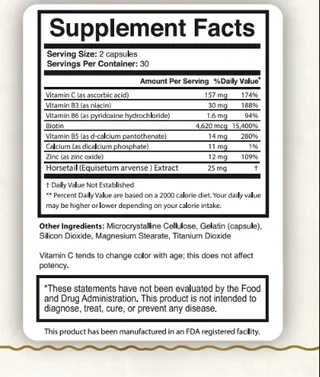
The Rosedil Capsules Supplement Facts panel gives a serving size of 2 capsules and 30 servings per container, followed by eight lines of amounts and percent Daily Values. This page reads the panel from top to bottom in the order it is printed, explains the one line with no Daily Value, and works through the biotin percentage as plain arithmetic. All figures come from the label image the owner supplied.
What does the Rosedil Capsules Supplement Facts panel say at the top?
The top of the panel says serving size 2 capsules and servings per container 30. Every amount below that line is for two capsules, not one.
A bottle holds 60 capsules, so a bottle is 30 servings, and at the label's two capsules daily that is 30 days a bottle. A common mistake is to read the figures as per capsule. Halve each number and you will have the per-capsule amount, but the label gives no per-capsule figures and the Daily Value percentages are calculated for the serving.
FDA's labeling guide describes the same layout: a panel shows serving size, servings per container, the amount per serving and the percent Daily Value, and lists ingredients.1 The Rosedil Capsules panel follows that layout as far as our image shows. We checked the format, not the accuracy of the numbers, which only a laboratory can confirm.
How do the eight lines of the panel read, one by one?
Each line has an ingredient name, the form in brackets where the label gives one, an amount and a percent Daily Value. The panel, as printed, reads in this order.
| Line | Ingredient and form | Amount per 2 capsules | %DV |
|---|---|---|---|
| 1 | Vitamin C (as ascorbic acid) | 157 mg | 174% |
| 2 | Vitamin B3 (as niacin) | 30 mg | 188% |
| 3 | Vitamin B6 (as pyridoxine hydrochloride) | 1.6 mg | 94% |
| 4 | Biotin | 4,620 mcg | 15,400% |
| 5 | Vitamin B5 (as d-calcium pantothenate) | 14 mg | 280% |
| 6 | Calcium (as dicalcium phosphate) | 11 mg | 1% |
| 7 | Zinc (as zinc oxide) | 12 mg | 109% |
| 8 | Horsetail (Equisetum arvense) Extract | 25 mg | † |
The dagger on the horsetail line points to a footnote on the panel that says no Daily Value is established. FDA's guide says a nutrient with no established Daily Value is shown with a dagger or footnote or the words "not established".1 The ingredients page holds the same eight lines with an NIH note on each.
Below the table the panel prints: "Percent Daily Values are based on a 2000 calorie diet." That sentence is the standard line explaining that a Daily Value is a reference number, not a target.
A second habit is useful when you compare this panel with another. Check three things before looking at any amount: the serving size, the number of servings, and the form in brackets. A product that lists zinc as citrate and one that lists zinc oxide can print the same number, and a serving of one capsule is half of a serving of two. Reading those three items first makes the comparison fair, and it is the same order FDA's layout presents them in. If any of the three is missing or unreadable on a label you are shown, that is a reason to ask for a clearer picture before you rely on the numbers.
050100 % of upper level
Our arithmetic from the label panel and NIH upper levels for adults. Biotin, B5 and horsetail have no upper level to compare with. An upper level is a ceiling for total intake from supplements, not a target; your other products count too.
Show the numbers
| Item | Value |
|---|---|
| Niacin, 30 mg of 35 mg | 86% |
| Zinc, 12 mg of 40 mg | 30% |
| Vitamin C, 157 mg of 2,000 mg | 8% |
| Vitamin B6, 1.6 mg of 100 mg | 2% |
Source: Label panel image; NIH Office of Dietary Supplements fact sheets; our arithmetic.
Why does the horsetail line have no percent Daily Value?
It has none because no Daily Value is established for horsetail, so the label marks it with a dagger instead of a percentage. The 25 mg is an amount of extract, and the label gives no extract ratio.
That matters for one reason: without a Daily Value, there is nothing to compare 25 mg against. We do not call the amount large or small, because we have no reference number to judge it by. Whether the extract is standardized to anything is not stated on the label, and neither is the plant part used. Our horsetail page covers the cautions.
What does the 15,400% biotin figure mean?
It means the biotin amount is 154 times the Daily Value, and that is all it means. The arithmetic is 4,620 mcg divided by the 30 mcg adult Daily Value that NIH lists, which gives 154, and 154 times 100 is 15,400%.2
A percent Daily Value is a ratio, and it grows with the amount; it does not measure anything about the body. Two things make the number look alarming, and neither is alarming by itself.
- NIH sets no upper level for biotin, and reports no evidence of toxicity at high intakes.2
- NIH does warn that high biotin intakes can cause falsely high or low results in some lab tests.2
The second point is the practical one. NIH advises telling your clinician and the lab that you take biotin before a test. Read the biotin lab tests page before any blood test.
To see how a percentage behaves, compare two lines. Vitamin B6 is printed at 94%, which is under the reference number, and vitamin B5 is printed at 280%, which is over it. Neither tells you anything about the bottle beyond the arithmetic: the Daily Value for B5 is 5 mg, so 14 mg passes it easily, while the B6 Daily Value is 1.7 mg and 1.6 mg falls just short. The percentage describes the size of the amount against the reference, nothing else.
How do the Rosedil Capsules amounts compare with NIH upper levels?
Four of the eight lines have an NIH upper level, which is the most NIH says adults can take daily from supplements and fortified foods without likely harm, and the amounts here fall below each one. The table puts the label amount beside the upper level, with the share as our arithmetic.
| Nutrient | Per 2 capsules | NIH upper level (adults, per day) | Share of the upper level |
|---|---|---|---|
| Vitamin C | 157 mg | 2,000 mg | about 8% |
| Niacin | 30 mg | 35 mg | about 86% |
| Vitamin B6 | 1.6 mg | 100 mg | 1.6% |
| Zinc | 12 mg | 40 mg | 30% |
| Biotin | 4,620 mcg | none set | not applicable |
| Vitamin B5 | 14 mg | see B vitamins | not shown here |
| Calcium | 11 mg | not in our sources | not shown here |
| Horsetail | 25 mg | none | not applicable |
The upper levels come from NIH fact sheets: niacin 35 mg from supplements and fortified foods,3 zinc 40 mg,4 vitamin C 2,000 mg5 and vitamin B6 100 mg.6 The niacin row is the closest one, at about 86%, which is why the niacin page exists. Each upper level counts everything you take in a day, so your other products matter more than this table.
The panel explorer on the ingredients page and the tally on the safety page let you add your own products.
What do the other ingredients and the color note say?
Below the panel, the label lists other ingredients: microcrystalline cellulose, gelatin (capsule), silicon dioxide, magnesium stearate and titanium dioxide. The label gives no amounts for them, which is normal for this section.
One more sentence is printed: vitamin C tends to change color with age, and the label says this does not affect potency. We cannot test that, so we report it as the label's statement. For the five other ingredients in plain words, see other ingredients.
What is not on the panel, and why does it matter?
The panel shows no proprietary blend, no lot number, no best-before date and no testing seal. Each of the eight ingredients has its own amount, so you can compare them with the references above without guessing.
What the panel cannot tell you:
- Who made the capsules; the label says only who distributes them.
- Whether the printed amounts match what a lab finds in a capsule.
- Whether the horsetail extract is standardized to anything.
- How long the amounts hold up in storage.
A panel is a maker's statement in a format set by rule, and it is worth reading, but it is not the same as a test result. The label page covers the rest of the wrap.
How should you use the panel before buying?
Use it as a checklist against your own list of supplements and medicines. Write down what you take, find the same nutrients, and add the Rosedil Capsules figures for two capsules to your total, not one.
If your total for niacin, zinc, vitamin B6 or vitamin C comes near an upper level, or if you have a lab test coming, ask a pharmacist or your clinician before you buy. Tell your providers about every supplement you take. If you are ready to compare, the owner's pack prices are on the pricing page, and the seller's page shows the live figures to confirm.
Questions people ask
What is the serving size on the Rosedil Capsules supplement facts panel?
The serving size is 2 capsules, and the panel lists 30 servings per container. A 60-capsule bottle is therefore 30 servings.
Why does the Rosedil Capsules supplement facts panel show 15,400% for biotin?
Because 4,620 mcg is 154 times the 30 mcg Daily Value. It is a ratio, and NIH sets no upper level for biotin, though it warns about lab-test interference.
Why is there no Daily Value for horsetail in Rosedil Capsules supplement facts?
No Daily Value is established for horsetail. The label marks the 25 mg line with a dagger rather than a percentage.
Are the Rosedil Capsules supplement facts amounts per capsule?
No. Every amount is for a serving of two capsules. Do not read a line as the amount in a single capsule.
Do the Rosedil Capsules supplement facts show a proprietary blend?
No. The label image lists each of the eight ingredients with its own amount and no combined blend weight.
Sources for this page
- FDA: Dietary Supplement Labeling Guide, Chapter IV. Nutrition Labeling. www.fda.gov
- NIH Office of Dietary Supplements: Biotin, Fact Sheet for Health Professionals. ods.od.nih.gov
- NIH Office of Dietary Supplements: Niacin, Fact Sheet for Health Professionals. ods.od.nih.gov
- NIH Office of Dietary Supplements: Zinc, Fact Sheet for Health Professionals. ods.od.nih.gov
- NIH Office of Dietary Supplements: Vitamin C, Fact Sheet for Health Professionals. ods.od.nih.gov
- NIH Office of Dietary Supplements: Vitamin B6, Fact Sheet for Health Professionals. ods.od.nih.gov
These statements have not been evaluated by the Food and Drug Administration. This product is not intended to diagnose, treat, cure, or prevent any disease. Safety: Rosedil Capsules are a dietary supplement, not a medicine. One serving (two capsules) lists 4,620 mcg of biotin, which can distort some lab tests (FDA), and 30 mg of niacin, close to NIH's 35 mg upper level for supplements. Ask your doctor or pharmacist before using them, especially if you are pregnant or nursing, under 18, have a medical condition or take medicine, and tell any lab you take biotin. Take no more than the label says, keep the bottle away from children, and report problems to FDA MedWatch. Rosedil is an independently run information site about Rosedil Capsules; the owner states it is the Official U.S. Rosedil shop, and we have not verified that. It is not the maker. We may earn money when you order through links marked as sponsored. The seller sets prices, shipping and refund terms; the prices here are the owner's list, so confirm at the live checkout.