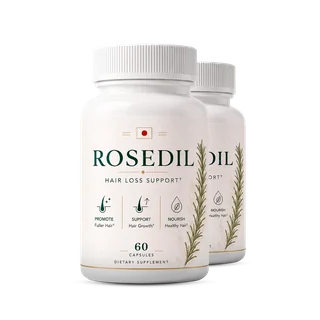
Rosedil Capsules list vitamin C, as ascorbic acid, at 157 mg per serving of two capsules, which the label prints as 174% of the Daily Value. Next to NIH's upper level of 2,000 mg a day, it is a small share. This page covers the arithmetic, what NIH says about stomach upset, kidney stones and iron, which foods carry vitamin C, and the label's own note about color.
How much vitamin C is in Rosedil Capsules?
One serving of Rosedil Capsules, which is two capsules, lists 157 mg of vitamin C, written on the panel as "Vitamin C (as ascorbic acid)". That is about 78.5 mg in each capsule and about 4,710 mg in a full 30-serving bottle (our arithmetic).
The figure comes from the Supplement Facts panel on the label image the owner supplied, and the panel prints a Daily Value of 174% beside it. Vitamin C is the first ingredient listed on the panel, followed by niacin, B6, biotin, B5, calcium, zinc and horsetail. For the whole list in one place, see supplement facts.
What is the Daily Value for vitamin C, and where does 174% come from?
The adult Daily Value for vitamin C is 90 mg, according to the NIH Office of Dietary Supplements.1 Divide 157 mg by 90 mg and you get 1.744, which rounds to the 174% on the panel.
A Daily Value is a reference number for comparing labels. It is not a target for any one person, and it is not a limit. The limit comes from a different NIH figure, the upper level, which is the next question. NIH also gives separate recommended amounts for different groups, such as smokers and pregnant women, so if you are in one of those groups, ask a clinician which figure applies to you.
What is the upper level for vitamin C?
NIH's tolerable upper intake level for adults is 2,000 mg a day of vitamin C, counting food and supplements together.1 One serving of Rosedil Capsules is 157 mg, which is about 8% of that level, leaving 1,843 mg under it (our arithmetic).
That makes vitamin C the line with the most room, which is the opposite of niacin. A second vitamin C product, such as a multivitamin or a drink mix, is unlikely to approach 2,000 mg by itself, but it still belongs on your tally. Our niacin page has a tool that adds vitamin C, niacin, zinc, B6 and biotin from your other products to one Rosedil serving.
| Vitamin C amount | What it is | Share of 2,000 mg upper level |
|---|---|---|
| 90 mg | Adult Daily Value | 4.5% |
| 157 mg | One Rosedil Capsules serving | about 8% |
| 2,000 mg | Adult upper level, food and supplements | 100% |
What happens with too much vitamin C?
NIH says large amounts of vitamin C cause diarrhea, nausea and abdominal cramps.1 These effects are tied to amounts around and above the upper level, which is far above the 157 mg on the Rosedil label.
Even so, people vary, and a stomach that is sensitive to supplements may react to any supplement taken on an empty stomach. The label directs two capsules daily with an 8 oz. glass of water, and the owner's pack says to take them with a main meal; either way, the instruction is to follow the label and not exceed it. If you notice stomach upset, stop and ask a pharmacist, and you can report problems to FDA through its MedWatch program.2 Our side effects page lists what official sources say about each ingredient.
What does NIH say about vitamin C and kidney stones?
NIH says the evidence on vitamin C and kidney stones is conflicting, and the concern is strongest for people who already have hyperoxaluria, a condition in which the body makes or absorbs too much oxalate.1 If you have had kidney stones, ask a clinician before using a vitamin C supplement.
This is a question about you, not about the capsules, and it applies to any vitamin C product. A history of stones, a family history of stones, or a diagnosis of hyperoxaluria are each reasons to mention vitamin C to the person who treats you. Bring the Supplement Facts panel so they can see the actual amount rather than the percentage.
What does vitamin C have to do with iron?
Vitamin C increases the absorption of non-heme iron, the form found in plants and in iron supplements.1 For most people that is only a fact about food. For people with hereditary hemochromatosis, a condition of iron overload, NIH says chronic high-dose vitamin C may worsen the overload.
The following people should ask a clinician before using any vitamin C supplement:
- anyone with hereditary hemochromatosis or another iron overload condition
- anyone with a history of kidney stones or hyperoxaluria
- anyone taking iron supplements who has been told to watch iron intake
- anyone under 18, pregnant or nursing, as the label's own caution says
Rosedil Capsules list no iron on the panel, so the capsules do not add iron themselves, though the panel is the only place we can check that, and the capsule fillers are listed separately on the label as other ingredients. The point is about what vitamin C does to the iron you eat or take elsewhere.
What should you tell a clinician about a vitamin C supplement?
Tell them the product name, the vitamin C amount per serving, and everything else you take, because NCCIH advises telling all your providers about every supplement and notes that "natural" does not mean safe.3 A short list is enough: the product, 157 mg of vitamin C per serving, and the date you started.
Bring the panel, not only the name. The same sentence on a label can hide very different amounts, and a clinician who sees 157 mg and the 174% figure can compare it with your diet, your history and your medicines. This takes two minutes and avoids guesswork, which is useful when the question involves iron, kidney stones or a medicine you cannot stop.
Which foods contain vitamin C?
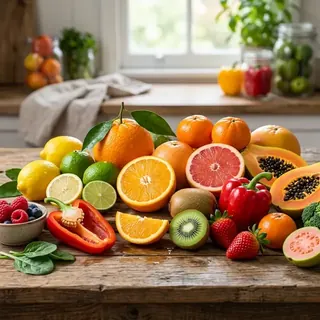
Vitamin C is found in many fruits and vegetables, and NIH lists citrus fruits, peppers, strawberries, tomatoes and broccoli among the foods that carry it.1 Most people who eat fruit and vegetables take in some vitamin C every day without a supplement.
Food counts toward the 2,000 mg upper level, so it belongs in your tally, but the amounts in a normal serving of food are far below the upper level. A glass of juice or a sweet pepper adds something, a supplement adds more, and the total is still a small share of the limit. Food does not carry the lab test concern that applies to biotin, which you can read about on our biotin lab tests page, nor the near-limit arithmetic that applies to niacin.
Why does the label say vitamin C changes color?
The label says: "Vitamin C tends to change color with age; this does not affect potency." That is the maker's own sentence, printed on the Supplement Facts panel in the label image the owner supplied.
We cannot check the claim about potency, and no test of the finished capsules is cited anywhere we looked. What you can check is the capsule itself: the label also says to keep the bottle away from heat, light and humidity in a cool, dry place, and not to use the product if the safety seal is damaged or missing. A visible change is a question for the order desk, not something to guess at. The label page reads each line of the bottle in order.
What should you do next?
A bottle holds 60 capsules, so at two capsules a day it lasts 30 days, and the 157 mg is the amount for each of those days. Tally your vitamin C if you use other products, ask a clinician if one of the groups above applies to you, and keep the lab-test page in mind for biotin. Vitamin C is the straightforward line on this panel; the lines that need more care are biotin and niacin.
The owner's pack lists prices, which you can compare on the pricing page and should confirm at the live checkout. If you decide to buy, you can see the packs at the seller's checkout, and the guarantee page covers what the pack says about the 60-day money-back terms and what it leaves open.
Questions people ask
How much vitamin C is in Rosedil Capsules per serving?
One serving of two capsules lists 157 mg of vitamin C, as ascorbic acid. That is 174% of the 90 mg Daily Value, according to the label image.
Is Rosedil Capsules vitamin C over the upper level?
No. NIH's upper level for adults is 2,000 mg a day from food and supplements, and one serving of Rosedil Capsules is 157 mg, about 8% of it.
Can Rosedil Capsules vitamin C upset my stomach?
It can in some people. NIH says large amounts of vitamin C cause diarrhea, nausea and cramps, and the amounts concerned are far above 157 mg. Stop and ask a pharmacist if you are unwell.
Is Rosedil Capsules vitamin C safe with kidney stones or hemochromatosis?
Ask a clinician first. NIH says the kidney stone evidence is conflicting and that chronic high-dose vitamin C may worsen iron overload in hereditary hemochromatosis.
Why does Rosedil Capsules vitamin C change color?
The label says vitamin C tends to change color with age and that this does not affect potency. We cannot verify that, so ask the order desk if the capsules look different.
Sources for this page
- NIH Office of Dietary Supplements: Vitamin C, Fact Sheet for Health Professionals. ods.od.nih.gov
- FDA: MedWatch, the FDA Safety Information and Adverse Event Reporting Program. www.fda.gov
- NCCIH: Using Dietary Supplements Wisely. www.nccih.nih.gov
These statements have not been evaluated by the Food and Drug Administration. This product is not intended to diagnose, treat, cure, or prevent any disease. Safety: Rosedil Capsules are a dietary supplement, not a medicine. One serving (two capsules) lists 4,620 mcg of biotin, which can distort some lab tests (FDA), and 30 mg of niacin, close to NIH's 35 mg upper level for supplements. Ask your doctor or pharmacist before using them, especially if you are pregnant or nursing, under 18, have a medical condition or take medicine, and tell any lab you take biotin. Take no more than the label says, keep the bottle away from children, and report problems to FDA MedWatch. Rosedil is an independently run information site about Rosedil Capsules; the owner states it is the Official U.S. Rosedil shop, and we have not verified that. It is not the maker. We may earn money when you order through links marked as sponsored. The seller sets prices, shipping and refund terms; the prices here are the owner's list, so confirm at the live checkout.