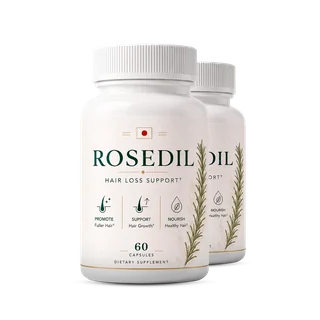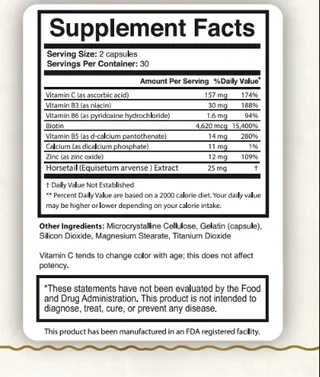
Rosedil Capsules list eight ingredients on the Supplement Facts panel and five more under other ingredients. The amounts below are per serving, which is two capsules, and they come from the label image the owner supplied. This page puts each figure beside the NIH Daily Value, notes where the percentages check out, and says what we could not confirm.
What are the ingredients in Rosedil Capsules?
Rosedil Capsules contain eight panel ingredients: vitamin C, niacin (vitamin B3), vitamin B6, biotin, vitamin B5, calcium, zinc and horsetail extract. The label then lists five other ingredients: microcrystalline cellulose, gelatin (capsule), silicon dioxide, magnesium stearate and titanium dioxide.
The panel shows amounts for two capsules, the label's serving, and a bottle holds 60 capsules, so 30 servings. Each form is printed in brackets on the label: vitamin C as ascorbic acid, niacin as niacin, vitamin B6 as pyridoxine hydrochloride, vitamin B5 as d-calcium pantothenate, calcium as dicalcium phosphate, zinc as zinc oxide, and horsetail as Equisetum arvense extract.
We report what the label prints and what NIH says. We do not describe what any of these does for hair, because nothing in our materials shows that. The label does print hair words of its own, which the label claims page examines in curly quotes with the FDA statement attached.
How much of each ingredient is in two Rosedil Capsules?
The table gives the label's amount per two capsules, the label's percent Daily Value, the NIH adult Daily Value, and one plain line from the NIH or MedlinePlus pages in our library. Each line is a fact about the nutrient, not a claim about the product.
| Ingredient | Per two capsules | Label %DV | NIH Daily Value | What the source says |
|---|---|---|---|---|
| Vitamin C (ascorbic acid) | 157 mg | 174% | 90 mg | Upper level 2,000 mg a day; very large doses can cause diarrhea and cramps1 |
| Niacin (vitamin B3) | 30 mg | 188% | 16 mg | Upper level 35 mg a day from supplements; flushing is typical at 30 to 50 mg of nicotinic acid2 |
| Vitamin B6 (pyridoxine HCl) | 1.6 mg | 94% | 1.7 mg | Upper level 100 mg a day for adults3 |
| Biotin | 4,620 mcg | 15,400% | 30 mcg | No upper level set; can distort some lab tests4 |
| Vitamin B5 (d-calcium pantothenate) | 14 mg | 280% | 5 mg | No upper level set |
| Calcium (dicalcium phosphate) | 11 mg | 1% | not in our sources | The label shows 1% |
| Zinc (zinc oxide) | 12 mg | 109% | 11 mg | Upper level 40 mg a day for adults6 |
| Horsetail (Equisetum arvense) extract | 25 mg | no DV | none | Crude horsetail may contain thiaminase |
The niacin line deserves a second look. Niacin 30 mg is 86% of the 35 mg upper level (our arithmetic), so a second niacin-containing product can push a day past it. The niacin page and the safety page cover adding things up.
02.55 of 5
Our own tally from the label image and the owner's pack; a rough guide, not a score for the product.
Show the numbers
| Item | Value |
|---|---|
| Name, form and count | 5 of 5 |
| Ingredients and amounts | 5 of 5 |
| Directions and cautions | 4 of 5 |
| Price and shipping | 2 of 5 |
| Guarantee terms | 2 of 5 |
| Maker, batch and tests | 0 of 5 |
Source: Label image; owner's pack.
Do the percent Daily Values on the Rosedil Capsules panel add up?
Yes, they check out against the NIH Daily Values to within rounding, by our arithmetic. Dividing the amount by the Daily Value reproduces each percentage on the label.
- Vitamin C: 157 ÷ 90 = 1.744, shown as 174%.
- Niacin: 30 ÷ 16 = 1.875, shown as 188%.
- Vitamin B6: 1.6 ÷ 1.7 = 0.941, shown as 94%.
- Biotin: 4,620 ÷ 30 = 154, shown as 15,400%.
- Vitamin B5: 14 ÷ 5 = 2.8, shown as 280%.
- Zinc: 12 ÷ 11 = 1.091, shown as 109%.
Calcium is the one line we cannot recompute, because our source library has no calcium Daily Value; the label's 1% is plain on the panel. A panel normally carries the serving size, servings per container, amount per serving and percent Daily Value, and marks a nutrient without an established Daily Value with a symbol or footnote.5 Horsetail is marked that way on this label.
A percentage over 100 is not an error. It is the arithmetic of a Daily Value that is a reference number, which is explained at length on the supplement facts page for biotin.
What are the other ingredients in Rosedil Capsules?
The other ingredients are microcrystalline cellulose, gelatin (capsule), silicon dioxide, magnesium stearate and titanium dioxide, listed after the panel on the label. These are the shell and the filling aids, and the label gives no amount for any of them.
Gelatin is the capsule shell, which means the capsules are not vegetarian; that is stated on the label itself and not an opinion of ours. If you avoid animal products, or have an allergy or religious dietary rule, ask the order desk before ordering. Our other ingredients page describes each of the five in plain words.
The label also carries one line about the vitamin C: it tends to change color with age, and the label says this does not affect potency. That is the label's statement, and we have no test to check it.
What does each ingredient page cover?
Each of the main ingredients has its own page, so this one stays short on detail. Use the list as a map.
- Vitamin C: the 157 mg line, the 90 mg Daily Value and the upper level.
- B vitamins: niacin, vitamin B6 and vitamin B5 together, with their upper levels.
- Niacin: why 30 mg sits close to the 35 mg upper level.
- Biotin: 4,620 mcg and what NIH says about the evidence.
- Zinc: 12 mg against a 40 mg upper level.
- Horsetail: the extract line with no Daily Value.
If you want the numbers interactively, tap an ingredient in the explorer below. It shows the amount, the percent Daily Value, the NIH Daily Value, the upper level where NIH sets one, and a plain note. It does not tell you what to take, and it adds nothing the table above does not already hold.
Tool · Panel explorer
Tap an ingredient to see its line on the label
Amounts are per serving (two capsules) as printed on the label image. Daily Values and upper levels are from NIH Office of Dietary Supplements fact sheets; an upper level is a ceiling for total daily intake from supplements and is not a target.
Pick an ingredient.
What does NIH say about biotin and hair in connection with Rosedil Capsules?
NIH says the evidence for biotin and hair is weak: a few case reports and small studies, with more studies needed, especially in healthy people.4 That is a statement about biotin in general, not about these capsules, and no study of the finished capsules is cited in our materials.
The same NIH page notes that high biotin intakes can cause falsely high or low results in some lab tests. NIH advises mentioning biotin to your clinician and lab when a test is planned. This is the single practical caution on the panel, and the biotin lab tests page gives the questions to ask.
The NIH zinc page lists hair loss as a sign of zinc deficiency mainly in older children, and does not say that zinc intake causes or treats hair loss.6 We mention it only so you do not read more into the zinc line than NIH does.
What could we not confirm about Rosedil Capsules ingredients?
We could not confirm who made the capsules, whether the finished capsules were tested for purity or amount, or how the extract was made. The label says only that it is distributed by a company in Lakeland, Florida, and that it was "manufactured in an FDA registered facility".
Here is the short list of what is unknown:
- The maker, and the supplier of each ingredient.
- Whether any laboratory has tested the finished capsules, and for what.
- The extract ratio behind the 25 mg of horsetail, which affects how much plant material it represents.
- The amounts of the five other ingredients.
- Whether the amount printed matches the amount in a capsule, since we have only a picture of a label.
A listed amount is the maker's statement, and if you want a test result, ask the order desk for a certificate of analysis for your bottle in writing. The order desk questions page has a ready list.
A word on forms. The panel prints the chemical form for most lines, such as zinc oxide and dicalcium phosphate. NIH notes that Supplement Facts panels list elemental zinc, so the 12 mg is the zinc itself and not the weight of the zinc oxide compound.6 When you compare this panel with another product, compare the same form and the same serving size, because a serving of two capsules is not the same as a serving of one.
Who should check the ingredients first?
Anyone who takes medicines, is pregnant or nursing, is under 18, has a medical condition, has a lab test coming, or avoids gelatin should check first. The label itself says that pregnant or nursing mothers, children under 18 and people with a known medical condition should consult a physician before using this or any dietary supplement.
Tell all your providers what you take. A pharmacist can compare the panel with your medicines in a few minutes. Bring a photo of the label, not a guess from memory.
If you are comparing prices at the same time, our pricing page lists the owner's pack prices, and you can see the seller's page once your questions are answered.
Questions people ask
What are the main Rosedil Capsules ingredients?
Rosedil Capsules list vitamin C, niacin, vitamin B6, biotin, vitamin B5, calcium, zinc and horsetail extract on the panel. Five other ingredients follow: microcrystalline cellulose, gelatin, silicon dioxide, magnesium stearate and titanium dioxide.
How much biotin is in Rosedil Capsules ingredients?
The label lists 4,620 mcg of biotin per two capsules. That is 15,400% of the 30 mcg Daily Value, and NIH sets no upper level for biotin.
Are Rosedil Capsules ingredients vegetarian?
No. The label lists gelatin as the capsule, which is an animal-derived ingredient, so these capsules are not vegetarian.
Do Rosedil Capsules ingredients include a proprietary blend?
No blend is printed on the label image. Each of the eight panel ingredients has its own amount, and horsetail has an amount with no Daily Value.
Is there a test of the Rosedil Capsules ingredients?
We found none cited in the owner's materials. The label does not name a testing body, so ask the order desk for written documentation.
Sources for this page
- NIH Office of Dietary Supplements: Vitamin C, Fact Sheet for Health Professionals. ods.od.nih.gov
- NIH Office of Dietary Supplements: Niacin, Fact Sheet for Health Professionals. ods.od.nih.gov
- NIH Office of Dietary Supplements: Vitamin B6, Fact Sheet for Health Professionals. ods.od.nih.gov
- NIH Office of Dietary Supplements: Biotin, Fact Sheet for Health Professionals. ods.od.nih.gov
- FDA: Dietary Supplement Labeling Guide, Chapter IV. Nutrition Labeling. www.fda.gov
- NIH Office of Dietary Supplements: Zinc, Fact Sheet for Health Professionals. ods.od.nih.gov
These statements have not been evaluated by the Food and Drug Administration. This product is not intended to diagnose, treat, cure, or prevent any disease. Safety: Rosedil Capsules are a dietary supplement, not a medicine. One serving (two capsules) lists 4,620 mcg of biotin, which can distort some lab tests (FDA), and 30 mg of niacin, close to NIH's 35 mg upper level for supplements. Ask your doctor or pharmacist before using them, especially if you are pregnant or nursing, under 18, have a medical condition or take medicine, and tell any lab you take biotin. Take no more than the label says, keep the bottle away from children, and report problems to FDA MedWatch. Rosedil is an independently run information site about Rosedil Capsules; the owner states it is the Official U.S. Rosedil shop, and we have not verified that. It is not the maker. We may earn money when you order through links marked as sponsored. The seller sets prices, shipping and refund terms; the prices here are the owner's list, so confirm at the live checkout.